
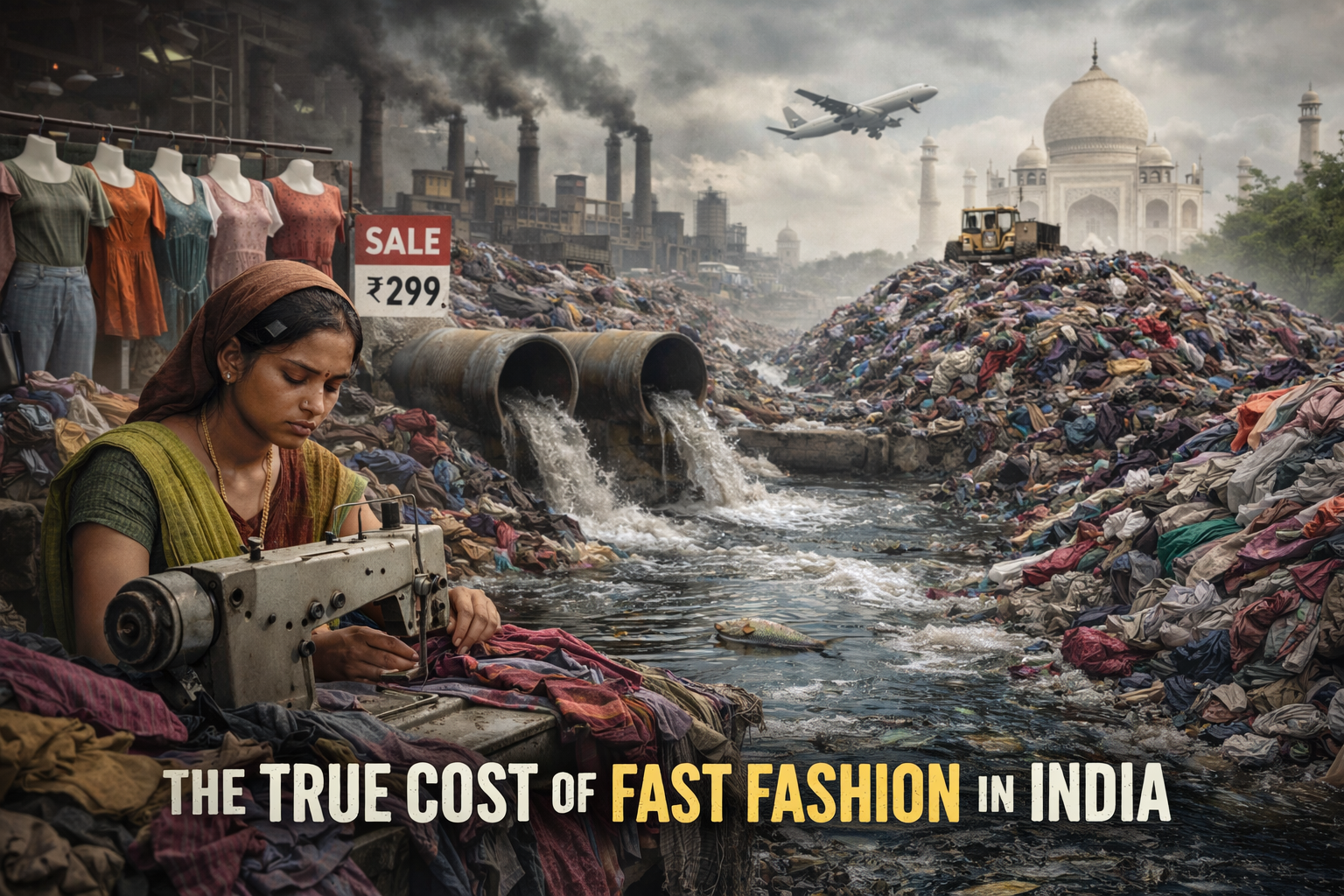
Fast fashion’s impact on India’s socio-economic, environmental, and cultural fabric (2025–2035)
Fast fashion has a price that never shows up on the tag. This report follows the unseen cost of fast fashion in India: the rivers, the soil, the workers and the waste. It draws on public research and reporting, listed under Works cited at the end, and looks at where fast fashion in India is heading over the next decade.
1. Introduction: The paradox of prosperity
The fashion industry is at a critical point of inflection, and India is the geopolitical and ecological pivot of the fast fashion industry. As of 2025, the story of the Indian textile industry is one of deep paradox. On the one hand, it is a economic giant, accounting for 2.3% of the country’s GDP, 12% of export earnings, and is the second-largest employment generator after agriculture, employing over 45 million people directly.1
The government’s ambitious plan is to increase the market size to US$ 350 billion by 2030, planning to triple export volumes to US$ 100 billion.3 On the other hand, this planned growth is being driven by a “fast fashion” business model, which is systematically depleting the country’s natural capital and undermining public health.
The “hurt” caused by fast fashion to India is not simply an aftereffect of industrialization; rather, it is a characteristic of a supply chain that is created to externalize costs. As long as global brands continue to source from India to reap the benefits of labor arbitrage, there has been a major shift in the global market itself. The rise of fast fashion brands like Zudio and Yousta has democratized trend-driven consumption in Tier-2 and Tier-3 cities, and the result is a volume-over-value paradigm.4
This report argues that the next decade of fast fashion in India (2025-2035) will be shaped by the intersection of these economic aspirations and the hard biophysical limits of water scarcity, waste unmanageability, and the rising disease burden of industrial pollution.
1.1 The fast fashion paradigm shift in India
Historically, the Indian textile tradition was based on the principles of “slow fashion” – robust handlooms and natural fabrics. However, the past decade has marked a clear shift. The fast fashion business paradigm, originally pioneered by Western companies, has been adopted with fervor by Indian conglomerates. As of 2025, the fast fashion industry has marked a clear shift in the consumer’s demand for high-frequency “drops” at extremely low price points.4
However, the fast fashion paradigm shift has far-reaching implications for the manufacturing sector as a whole. In order to keep their prices competitive (for example, T-shirts for as low as INR 199), the manufacturing sector has had to compromise on environmental regulations and worker safety. 5. Moreover, there has been a reliance on cheaper synthetic materials such as polyester, which now form a substantial part of the raw material mix. 6
1.2 Report scope and objective
This analysis examines the multi-dimensional effects of the fast fashion sector on the Indian economy. It goes beyond the surface level to examine second-order effects, such as how water pollution in Ludhiana leads to cancer clusters, how the need for cheap labor in Tamil Nadu leads to an evolution of traditional forms of bonded labor, and how the international waste trade leads to Panipat being a toxic dumpsite. Finally, it offers a projection for the 2025-2035 decade, examining how the impending conflict between European Union sustainability laws and resource depletion will lead to a bifurcation of this sector.

2. The hydrological catastrophe: Bleeding the rivers dry
The most pressing and existential risk that is posed by the fast fashion industry is the effect that it has on the hydrological systems in India. The textile industry is highly chemical-dependent and water-hungry. With 600 million Indians already experiencing high to extreme water stress, the growth pattern of the textile industry, driven by fast fashion, is headed for a collision course with human needs. 8
2.1 Tirupur: The limits of the “Zero Liquid Discharge” miracle
The case study of Tirupur in the state of Tamil Nadu, also known as the “Knitwear Capital” globally, is a complex one. In the wake of the destruction caused to the Noyyal River, which was a life-giving source for the agricultural sector in the region, the Madras High Court directed the implementation of Zero Liquid Discharge technology in all dyeing units in 2011. 10
2.1.1 The technical and economic reality of ZLD
The Tirupur “green” hub story is only partially true and very clean. The region has 18 Common Effluent Treatment Plants (CETPs) and very high water recycling rates, reclaiming up to 130 million liters every day. 12 However, the ground reality is very challenging:
- Energy Intensity and Cost: The ZLD process, which includes reverse osmosis and multi-effect evaporation, is extremely energy-intensive. This increases the cost of production substantially, further pressuring the margins of Small and Medium Enterprises (SMEs), which are prevalent in the cluster. 14
- The Paradox of Sludge: Despite being a water-recovery process, mixed salt sludge is a paradoxically hazardous byproduct of ZLD. The sludge, a hazardous solid waste, has not yet been disposed of appropriately. It is currently stored in enormous yards, which can contaminate the same groundwater that the ZLD process was designed to protect by seeping into the soil during monsoons. 12
- Groundwater Legacy: Even with current recycling initiatives, the past impact on the aquifer is significant. According to studies, groundwater in the Avinashi-Tirupur-Palladam area remains contaminated with high TDS and chloride levels, rendering it unfit for drinking or irrigation. 15 While the restoration of groundwater levels is frequently reported, it can obscure the quality of the water.
2.1.2 Illegal discharge and enforcement gaps
The economic stress of fast fashion, in which consumers increasingly demand lower prices with each passing season, provides a perverse incentive to skirt around ZLD technology. During periods of high rainfall or at night, untreated effluents are allegedly released into the Noyyal to cut costs on electricity and chemical consumption.17 This shock-loading pattern prevents the riverine ecosystem from recovering, keeping the Noyyal River a “dead river” for most of its length.
2.2 Ludhiana: The toxic veins of the Buddha Nullah
Whereas Tirupur is struggling with remediation, Ludhiana is a catastrophic failure of governance and industrial stewardship. As a hub for winter wear and denim processing, Ludhiana’s dyeing units have transformed the Buddha Nullah, a seasonal stream, into a poisonous vein that infects the Sutlej River.18
2.2.1 The chemistry of poison
The pollution pattern of the Buddha Nullah is unique and toxic. While the sewage water contains organic pollutants, the industrial effluent in this case is replete with heavy metals.
- Heavy Metal Poisoning: Research carried out in 2024 and 2025 using Atomic Absorption Spectrophotometry has established the presence of Lead, Chromium, Arsenic, and Nickel beyond BIS standards.18
- Genotoxicity: The water is not only polluted but also mutagenic. Bioassays performed on Allium cepa (onion root) have shown that the water of the Buddha Nullah causes chromosomal aberrations and DNA damage. This indicates that the pollutants have the potential to alter the genetic material, which is a direct biological explanation for the large number of cancer cases reported in the area.18
2.2.2 The “Cancer Train” phenomenon
The socio-health effects of this pollution are geographically large. The Sutlej River transports these pollutants into the Malwa region of Punjab and then into Rajasthan. The incidence of cancer, bone ailments, and nervous system diseases in these areas is statistically significantly higher than the national average.19 The infamous “Cancer Train” that transports patients from Punjab to Bikaner for treatment is a direct result of this environmental neglect.
2.2.3 Institutional paralysis
Despite intervention by the National Green Tribunal (NGT) and the Central Pollution Control Board (CPCB), adherence to the order has been difficult. In 2025, it was reported that CETPs were operating at sub-capacity or being completely bypassed. The Punjab Pollution Control Board (PPCB) has been criticized for not acting on the closure orders of non-compliant facilities, indicating the political-economic establishment of the sector.20
2.3 Surat: The synthetic chemical soup
Surat deals with the majority of India’s synthetic fabrics, such as polyester, nylon, and viscose. This sector is the backbone of fast fashion because of its low price and adaptability.
- Chemical Intensity: The chemicals used for processing synthetic fast fashion fabrics include disperse dyes and carriers, such as chlorinated benzenes, which are POPs.
- Deep Sea Discharge: The “solution” in Surat has been to pipe the waste deep into the sea. But this problem is simply shifted from the land to the sea, which affects the marine ecosystem.23
- Groundwater Contamination: In industrial areas such as Kadodara, the groundwater is seriously polluted, causing damage to crops and dermatitis in the village population.24
Table 1: Comparative Analysis of Water Stress in Key Textile Hubs (2025 Status)
| Cluster | Primary Product | Key Pollutants | Status of Remediation | Future Risk (2030) |
|---|---|---|---|---|
| Tirupur | Cotton Knitwear | Salts, Dyes, Sludge | ZLD implemented but costly; sludge accumulation issues. | High: Groundwater depletion threatens production continuity. |
| Ludhiana | Wool/Acrylic/Denim | Heavy Metals (Pb, Cr, As) | CETPs frequently non-compliant; severe downstream health impact. | Critical: NGT may force mass closures due to health crisis. |
| Surat | Synthetics (MMF) | Disperse Dyes, TDS | Marine discharge; weak groundwater protection. | Medium-High: Increasing salinity and chemical toxicity in aquifers. |
3. The toxic legacy: Microplastics, soil, and air
Whereas water pollution is a visible and tangible problem, the fast fashion industry is also guilty of insidious types of pollution that seep into the soil and air, often beyond the reach of conventional regulatory frameworks.
3.1 The microplastic crisis
The rise of synthetic fabrics (polyester, acrylic) in fast fashion has precipitated a microplastic crisis. Each time a synthetic fabric garment is washed, it releases thousands of microfibers. In manufacturing hubs, this process occurs on an industrial scale during the washing and finishing process.7

3.1.1 Riverine transport and bioaccumulation
Recent studies on the Ganges and Noyyal rivers have completely changed our understanding of this fast fashion threat.
- The Ganges Study: A study conducted by Toxics Link found that there are 40 different forms of microplastics in the Ganges, and the highest levels are found near industrial cities such as Kanpur and Varanasi. These microplastics adsorb other pollutants (such as pesticides and heavy metals) and enter the aquatic food chain.25
- Seasonal Cycles in the Noyyal: Studies have shown that microplastic pollution is not constant. In the dry summer months, microplastics are trapped in river sediments, breaking down and becoming more brittle (and thus smaller and more bioavailable). The monsoon season is then a “flush” that releases these trapped plastics into the water column in massive shock loads.26
- Consequences: This periodic release of plastics poses an “extreme danger threat” to the environment, as measured by the Polymer Hazard Index (PHI), during the period of transition from the dry to wet season.27
3.2 Soil degradation and agricultural collapse
As fast fashion volumes grow, the nexus between the textile industry and agriculture is turning increasingly antagonistic.
- Sludge Dumping: The solid waste produced by effluent treatment plants is frequently dumped on agricultural land or used for landfilling in unlined pits. This sludge is rich in precipitated heavy metals and salts.28
- Sterilization of Land: Farmers living around textile agglomerations have noticed that the soil has turned hard and salty, resulting in a substantial decrease in crop output. This fuels a vicious cycle where farmers, having lost their means of livelihood, are compelled to look for low-paying jobs in the very factories that are destroying their land—a process of “proletarianization by pollution”.29
3.3 Air pollution and incineration
The disposal of fast fashion at the end of its life cycle also affects air pollution. Since there is no feasible recycling option for mixed blends, a huge amount of textile waste is burned.
- Dioxin Emissions: The burning of synthetic fabrics emits dioxins and furans, highly toxic and carcinogenic substances, into the air. This is most common in the informal recycling points and dumping sites such as Ghazipur in Delhi, where textile waste is a substantial fuel material that keeps landfill fires burning constantly.30
4. The human cost of fast fashion: Labor, health, and inequality
The economic viability of fast fashion in India is largely dependent on labor arbitrage, or keeping costs low and turning out garments quickly. This makes for a precarious existence for the millions of workers, mostly women, who form the backbone of the fast fashion industry. The cost of fast fashion is not merely economic but somatic, inscribed on the bodies of the workers through illness and fatigue.
4.1 The persistence of exploitative labor regimes
Nonetheless, despite being under international observation for many years, exploitative labor practices in fast fashion supply chains remain, and they often change forms to avoid being regulated.
4.1.1 The mutated Sumangali scheme
In the state of Tamil Nadu, the notorious “Sumangali” system, in which young women were lured from poor communities with the promise of a one-time payment for their marriage dowry after a certain period of time, has been abolished but has taken a new form.
- Current Status (2024-2025): According to recent reports, although the exact form of “Sumangali” branding is no longer in the limelight, the underlying framework continues to be in place. Young women are lured into spinning mills and garment units with contracts that limit their mobility (hostel detention), force them to work long hours of overtime, and cut their salaries.32
- Forced Labor: The “Mutated Sumangali” system may include the denial of minimum wage payments, forced overtime, and the denial of freedom of association. Workers are held captive by their own economic conditions and the social pressure to raise money for their marriage, which they are then exploited for by the industry.32
4.1.2 Gender-based violence (GBV)
The fast fashion floor is an area of systemic gender inequality. Women dominate the workforce in the cut and sew production stages but are nearly absent from management positions. The lack of power equality creates a setting conducive to verbal harassment and abuse. The constant need to meet hourly production quotas, fueled by the fast fashion “just in time” system, directly correlates to verbal and physical aggression exhibited by supervisors against female employees.34
4.2 Occupational health epidemics
The health impacts of fast fashion production are medically recorded but remain unattended in policy formulation.
4.2.1 Byssinosis (brown lung)
The spinning units, especially in the Surat region and the North Indian areas, are heavily exposed to cotton dust.
- Prevalence: The prevalence rate of byssinosis, a chronic respiratory ailment, has been recorded to be as high as 35-44% in certain sections of the spinning mills.36 Although technological advancements have reduced the risk, the absence of proper ventilation and Personal Protective Equipment in older spinning mills and SME units continues to maintain such high levels.38
4.2.2 Chemical exposure and dermatitis
In the dyeing and printing sections of fast fashion supply chains, the workers are exposed to carcinogenic azo dyes, fixing agents, and solvents.
- Morbidity Profile: A study conducted in 2023 among migrant workers in Surat showed that 95% of them were affected by occupational morbidities. The most affected were musculoskeletal disorders (72.7%), followed by ophthalmic disorders (27.6%) and skin diseases (23.9%), which were caused by exposure to chemicals.39
- Lack of Safety Net: These workers are mostly migrants who lack access to healthcare and social security. Once they fall ill, they are let go, thus “exporting” the health crisis to their villages of origin. 40
4.3 The living wage debate: A 2025 turning point?
A major change is looming on the horizon with respect to compensation for fast fashion workers. As it stands, the minimum wage that is legally required in many states is not enough to sustain a living wage.
- The Transition: The Indian government, in partnership with the International Labor Organization (ILO), is currently looking at the transition from a “Minimum Wage” to a “Living Wage” system by 2025.41
- Implications: The living wage will include provisions for housing, healthcare, and education, which is higher than the current minimum wage. Although this is set to bring hope to millions, it directly challenges the fast fashion industry model, which is based on keeping wages low. Industry insiders forecast major pushback from manufacturers and possibly rapid automation to compensate for this.42
5. The waste avalanche: Panipat and the crisis of circularity
India holds a special place in the international fast fashion waste chain: it is the largest consumer of second-hand clothing in the world, but it does not have the infrastructure to support its own waste production.
5.1 Panipat: The cast-off capital in crisis
Panipat is the world’s recycling capital for woolens and cottons, processing massive amounts of the world’s discarded clothing.44 This “shoddy” industry has a long history as a model of mechanical recycling, turning wool coats into blankets. But fast fashion has disrupted this model.
5.1.1 The polyester contamination
The dumping of low-cost poly-blend fast fashion clothing has contaminated the recycling stream.
- Technical Failure: The mechanical recycling equipment in Panipat is not capable of separating polyester from wool or cotton. Items containing <80% natural fibers are considered to be of little value for high-quality recycling.
- Waste Colonization: As the Global North sends more of its low-grade poly-blend fast fashion, Panipat is no longer a recycling center but a dumpsite. A large amount of the imported trash that cannot be recycled is dumped into local landfills or burned as fuel for boilers, emitting toxic gases.6
5.2 The domestic landfill emergency
Domestically, India produces about 7.8 million tonnes of textile waste every year, and this is set to increase in tandem with the rise of fast fashion in India.30
- Urban Waste: In Indian cities such as Delhi and Mumbai, textile waste is the third-largest source of dry waste. Ghazipur landfills are choked with synthetic rags. These textiles are not biodegradable because they are made of synthetic materials. They absorb heat and methane gas, which causes the regular and life-threatening fires observed at these landfills.31
- The “Invisible” Waste: Pre-consumer waste, which includes factory cuttings and scraps, represents 51% of the total waste. Although some of this waste is downcycled, a large amount from the unorganized sector is burned in open pits, which is a major cause of India’s air quality problem.30
6. Regulatory headwinds & geopolitical shifts (2025–2030)
Over the next five to ten years, Indian textile exporters, and the fast fashion brands they supply, will face a wave of new rules coming from the European Union. These changes won’t be cosmetic—they will fundamentally alter how textiles are designed, made, tracked, and sold.
6.1 The EU Strategy for Sustainable and Circular Textiles
The EU’s Green Deal and its new sustainability laws are set to change the rules of the game for anyone exporting textiles to Europe—including India.
- Extended Producer Responsibility (EPR):
By 2025, the EU will introduce mandatory EPR rules for textiles. This means brands selling in Europe, fast fashion labels included, will have to pay for the waste their products create after use. These costs and responsibilities will move down the supply chain. Indian manufacturers will be under pressure to make products that last longer and can be recycled easily if they want to continue supplying EU brands.46 - Digital Product Passports (DPP):
Upcoming regulations will require every product to carry a digital record showing its environmental impact, recycled content, and chemical safety details. This level of transparency is something most Indian small and medium manufacturers are not currently equipped to provide.48 - The Exclusion Risk:
Large Indian exporters (Tier 1) are already investing in tracking and traceability systems to meet these requirements. However, many Tier 2 and Tier 3 subcontractors may be unable to comply. As a result, they risk being pushed out of global supply chains altogether, leading to industry consolidation and potential job losses in the informal sector.47
6.2 India’s domestic policy response
India is not just reacting to international regulations; it is also working on building its own policy framework for the textile sector and its fast fashion market at home.
- Project SU.RE (Sustainable Resolution):
Project SU.RE was introduced as a voluntary initiative by major Indian brands such as Reliance Retail and Aditya Birla Fashion. The goal was to shift toward sustainable sourcing by 2025. While the initiative showed intent and awareness, the absence of legally binding targets has limited its ability to drive large-scale, lasting change.50 - Draft National Textile Policy & Domestic EPR:
India is expected to roll out its own Extended Producer Responsibility (EPR) rules for textiles, likely based on the model used in the Plastic Waste Management Rules. Under this system, brands would be required to collect and recycle a fixed portion of the textiles they sell. If implemented around 2026, as currently expected, this could create a structured domestic recycling market and encourage investment in established recycling hubs such as Panipat.46
7. Future forecast (2025–2035): Scenarios and trajectories
Based on the synthesis of current data, environmental constraints, and policy trends, the next decade will witness a bifurcation of the Indian textile sector. The fast fashion “business as usual” scenario is no longer viable due to the physical exhaustion of water resources and the closing of regulatory windows in export markets.
7.1 Scenario A: The export-grade transformation (the “green” tier)
Top-tier exporters (approximately 20% of the market) will successfully integrate into the new global circular economy.
- Technology Adoption: These units will adopt waterless dyeing technologies, comprehensive ZLD, and blockchain-based traceability for DPP compliance.
- Energy Shift: A rapid transition to 100% renewable energy (solar/wind) to meet the carbon neutrality targets of global brands.12
- Labor: Formalization of the workforce with living wages to meet stringent social audit standards required by EU/US buyers.
- Outcome: This segment will grow in value but potentially shrink in volume as the global market moves away from “disposable” fast fashion.
7.2 Scenario B: The domestic fast fashion trap (the “grey” tier)
The remaining 80% of the market, catering to domestic consumers and non-regulated export markets, faces a grim trajectory.
- Resource Conflict: As water becomes scarcer, state governments will face political pressure to prioritize agriculture and drinking water over textile units. We anticipate “water riots” or forced closures of dyeing units in water-stressed zones like Pali and Tirupur during drought years (2027–2032).53
- Pollution Havens: Without strict enforcement of domestic EPR, India risks becoming a dumping ground for low-quality synthetic fast fashion. The domestic market, driven by price sensitivity, may continue to consume polluting products, creating a “two-speed” India where export goods are clean and domestic goods are toxic.
- Public Health Crisis: The cumulative effect of microplastics and heavy metals will lead to measurable spikes in chronic diseases (cancer, renal failure) in river basins like the Sutlej and Noyyal. This will likely trigger class-action litigations and severe judicial crackdowns similar to the 2011 Tirupur closure.54
7.3 The automation disruption
By 2030, the “cheap labor” advantage that fast fashion relies on will erode due to the Living Wage implementation and labor shortages.
- Prediction: Widespread adoption of automation in cutting and sewing (sewbots) will become necessary to maintain margins. While this increases efficiency and reduces waste, it will lead to significant job displacement for low-skilled female workers. Without an aggressive reskilling policy, this could trigger a social crisis in textile-dependent states like Tamil Nadu and Karnataka.56
Table 2: Strategic Risk Matrix (2025-2035)
| Risk Category | Probability | Impact | Description |
|---|---|---|---|
| Water Insolvency | Very High | Catastrophic | Key hubs (North India) run out of usable groundwater; forced migration of industry. |
| Regulatory Exclusion | High | High | MSMEs fail to meet EU/US sustainability norms; export collapse for small players. |
| Health Crisis | High | Severe | Escalation of cancer/organ failure rates in river basins; judicial shutdown of clusters. |
| Waste Management Failure | Medium | High | Landfills reach capacity; failure of recycling tech to handle poly-blends leading to toxic fires. |
8. Conclusion
The fast fashion model is fundamentally incompatible with India’s ecological limitations and social aspirations for the next decade. While the sector promises economic growth to US$ 350 billion, this figure effectively “externalizes” the cost of water destruction, public health degradation, and waste management.
The “hurt” of fast fashion is already visible: rivers turned into chemical drains in Ludhiana, workers suffering from brown lung in Surat, and mountains of waste accumulating in Panipat. The next 5–10 years will be a period of painful correction. The era of laissez-faire pollution is ending, driven not just by domestic altruism but by hard constraints—water running out and export markets closing their doors to dirty products.
Strategic Imperative: To move beyond fast fashion, India must urgently pivot from being the “world’s sweatshop” to becoming the “world’s circular workshop.” This requires strict enforcement of pollution norms regardless of unit size, immediate investment in textile-to-textile recycling technologies, and a “Just Transition” framework to protect the millions of workers who face displacement. Failure to execute this transition will not merely stifle economic growth; it will result in irreversible ecological damage that no amount of textile exports can pay for.
What the cost of fast fashion means for how we make clothes
This research shaped how EKVAAR works. We are a House of Originals, made in India, and we do not chase weekly drops. Each piece is made for you once you reserve it, so we are not producing racks of unsold stock that could end up in the waste streams described in section 5. That is our answer to fast fashion: fewer pieces, made properly, made only when someone wants them. You can read how it works in our guide to made-to-order clothing in India.

It is not a complete fix. Most of what this report describes needs policy, enforcement and investment at scale. But buyers have a part to play too. Before you buy, ask what a piece is made of, where it is made and how long you will wear it. A piece you wear for years asks less of rivers and landfills than a stack of fast fashion tops worn a few times each.
If you want a place to start, our list of fast fashion alternatives in India covers affordable options, and the ORIGINAL Hoodie shows how we describe a piece: 300 GSM brushed cotton fleece, made in India, made for you. Moving away from fast fashion starts with knowing what you are buying. For background on the wider debate, see the EU Strategy for Sustainable and Circular Textiles.
Works cited
- Textile Transformation: India’s Strategic Weave Into The Future, accessed January 29, 2026, https://www.textileworld.com/textile-world/2025/01/textile-transformation-indias-strategic-weave-into-the-future/
- Rethinking: Textile sector – KPMG International, accessed January 29, 2026, https://kpmg.com/in/en/blogs/2025/02/rethinking-textile-sector.html
- Textile Industry & Market Growth in India – IBEF, accessed January 29, 2026, https://www.ibef.org/industry/textiles
- Faster Trends, Wiser Shoppers: India’s Fashion Upgrade In 2025 – BW Businessworld, accessed January 29, 2026, https://www.businessworld.in/article/faster-trends-wiser-shoppers-india-s-fashion-upgrade-in-2025-584409
- Sustainable fashion in India: Can ethics and scale Coexist? | YourStory, accessed January 29, 2026, https://yourstory.com/2026/01/sustainable-fashion-india-ethics-scale
- The State Of Textile Waste In India – Reports – Fashion for Good, accessed January 29, 2026, https://reports.fashionforgood.com/report/sorting-for-circularity-india-wealth-in-waste/chapterdetail?reportid=813&chapter=3
- How India’s Fast Fashion Boom is Fuelling a Textile Waste Crisis – Outlook Business, accessed January 29, 2026, https://www.outlookbusiness.com/magazine/how-indias-fast-fashion-boom-is-fuelling-a-textile-waste-crisis
- Composite Water Management Index – NITI Aayog, accessed January 29, 2026, https://www.niti.gov.in/sites/default/files/2023-03/CompositeWaterManagementIndex.pdf
- Composite Water Resources Management: Performance of States – NITI Aayog, accessed January 29, 2026, https://www.niti.gov.in/sites/default/files/2023-03/CompositeWaterManagementIndex-CWMI.pdf
- The Impact of ‘Zero’ Coming into Fashion: ZLD Uptake and Socio-Technical Transitions in Tirupur – Water Alternatives, accessed January 29, 2026, https://www.water-alternatives.org/index.php/alldoc/articles/vol10/v10issue2/372-a10-2-22/file
- India’s knitwear capital Tiruppur goes green – Gulf News, accessed January 29, 2026, https://gulfnews.com/world/asia/india/indias-knitwear-capital-tiruppur-goes-green-1.500184882
- Sustainability fuelling Tiruppur’s vision for long-term growth – Fibre2Fashion, accessed January 29, 2026, https://www.fibre2fashion.com/news/sustainability-news/sustainability-fuelling-tiruppur-s-vision-for-long-term-growth-300698-newsdetails.htm
- PM Modi lauds Veerapandi Common Effluent Treatment Plant in Tirupur | Coimbatore News – The Times of India, accessed January 29, 2026, https://timesofindia.indiatimes.com/city/coimbatore/pm-modi-lauds-veerapandi-common-effluent-treatment-plant-in-tirupur/articleshow/119763763.cms
- Rs. 200-cr. Central funds to end Tirupur dyeing industry crisis – The Textile Magazine, accessed January 29, 2026, https://www.indiantextilemagazine.in/rs-200-cr-central-funds-to-end-tirupur-dyeing-industry-crisis/
- Assessment of Industrial Impact on Groundwater Quality in Tirupur District: A Statistical Analysis – Current World Environment, accessed January 29, 2026, https://www.cwejournal.org/article/passessment-of-industrial-impact-on-groundwater-quality-in-tirupur-district-a-statistical-analysisp
- Assessment of Groundwater Pollution Due to Textile Industrial Activities in and Around Tirupur Region, Tamil Nadu, India – Semantic Scholar, accessed January 29, 2026, https://pdfs.semanticscholar.org/2bff/65ba5d14af52c2c193046b0e07b61723e44d.pdf
- India’s Textile City of Tiruppur is an Environmental Dark Spot – The Wire Science, accessed January 29, 2026, https://science.thewire.in/economy/agriculture/australian-open-tiruppur-dyeing-bleaching-groundwater-contamination-agriculture-noyyal-river/
- A study on water quality monitoring of Buddha Nullah, Ludhiana, Punjab (India) – PubMed, accessed January 29, 2026, https://pubmed.ncbi.nlm.nih.gov/32949005/
- Poisoned Punjab: Cancers, dental problems plague Ludhiana village residents, accessed January 29, 2026, https://www.downtoearth.org.in/pollution/poisoned-punjab-cancers-dental-problems-plague-ludhiana-village-residents-89689
- Shut dyeing waste outlets polluting Buddha Dariya: Activists to PPCB | Ludhiana News – The Times of India, accessed January 29, 2026, https://timesofindia.indiatimes.com/city/ludhiana/shut-dyeing-waste-outlets-polluting-buddha-dariya-activists-to-ppcb/articleshow/126326065.cms
- Before the Hon’ble National Green Tribunal, Principal Bench, New Delhi, Appeal No. 40 of 2024, accessed January 29, 2026, https://www.greentribunal.gov.in/sites/default/files/news_updates/Reply%20by%20PPCB%20in%20Appeal%20No.%2040%20of%202024%20(Punjab%20Dyers%20Association%20Vs.%20PPCB).pdf
- Ludhiana’s Dyeing Industry In Trouble As NGT Questions CETPs in Buddha Nullah Pollution Case – KNN India, accessed January 29, 2026, https://knnindia.co.in/news/newsdetails/sectors/others/ludhianas-dyeing-industry-in-trouble-as-ngt-questions-cetps-in-buddha-nullah-pollution-case
- Stitching sustainability amidst climate change challenges – Mongabay-India, accessed January 29, 2026, https://india.mongabay.com/2024/02/stitching-sustainability-amidst-climate-change-challenges/
- Impact on ground water due to textile industries in Kadodara Region, Surat, Gujarat, India – ResearchGate, accessed January 29, 2026, https://www.researchgate.net/publication/333986140_Impact_on_ground_water_due_to_textile_industries_in_Kadodara_Region_Surat_Gujarat_India
- Microplastics in the Ganga River – How Dangerous is the Situation? – TERI, accessed January 29, 2026, https://www.teriin.org/article/microplastics-ganga-river-how-dangerous-situation
- Seasonal influence on microplastics in the sediments of a non-perennial river – Noyyal, Tamil Nadu, India – ResearchGate, accessed January 29, 2026, https://www.researchgate.net/publication/373216339_Seasonal_influence_on_microplastics_in_the_sediments_of_a_non-perennial_river_-Noyyal_Tamil_Nadu_India
- Seasonal influence on microplastics in the sediments of a non-perennial river – Noyyal, Tamil Nadu, India – PubMed, accessed January 29, 2026, https://pubmed.ncbi.nlm.nih.gov/37597138/
- The environmental impact of the textile sector – Hedgehog, accessed January 29, 2026, https://www.hhc.earth/knowledge-base/articles/the-environmental-impact-of-the-textile-sector
- Assessing Environmental and Health Impacts of the Dyeing and Bleaching Industry in Tirupur, Tamil Nadu – EPRA Blogs, accessed January 29, 2026, https://eprajournals.com/pdf/fm/jpanel/upload/2024/October/202410-01-018763
- India Textile Waste Statistics – Report 2026 – Rawshot.ai, accessed January 29, 2026, https://rawshot.ai/statistic/india-textile-waste
- Action Research for Waste Reduction – NITI Aayog, accessed January 29, 2026, https://www.niti.gov.in/sites/default/files/2023-03/Final%20Report-Action%20Research%20for%20Waste%20Reduction.pdf
- Factsheet: India’s Clothing Industry – FEMNET, accessed January 29, 2026, https://femnet.de/en/information-en/country-working-conditions/india.html
- Fighting the Sumangali scheme – Laudes Foundation, accessed January 29, 2026, https://www.laudesfoundation.org/latest/research-and-lessons/lessons/2020/fighting-the-sumangali-scheme/
- The price of fast fashion is not pretty | British Safety Council India, accessed January 29, 2026, https://www.britsafe.in/safety-management-news/2025/the-price-of-fast-fashion-is-not-pretty
- Beneath the Seams: The Human Toll of Fast Fashion – Earth Day, accessed January 29, 2026, https://www.earthday.org/beneath-the-seams-the-human-toll-of-fast-fashion/
- Prevalence of byssinosis in spinning and textile workers of Karachi, Pakistan – PubMed, accessed January 29, 2026, https://pubmed.ncbi.nlm.nih.gov/18980877/
- Cotton Dust Exposure and Respiratory Disorders among Textile Workers at a Textile Company in the Southern Part of Benin – MDPI, accessed January 29, 2026, https://www.mdpi.com/1660-4601/13/9/895
- Prevalence of byssinosis and respiratory symptoms among cotton mill workers – PubMed, accessed January 29, 2026, https://pubmed.ncbi.nlm.nih.gov/11844963/
- Prevalence and prediction of occupational morbidities among male migrant workers in textile industries in Surat, India: a cross-sectional study, accessed January 29, 2026, https://www.ijcmph.com/index.php/ijcmph/article/view/11145
- Prevalence and prediction of occupational morbidities among male migrant workers in textile industries in Surat, India, accessed January 29, 2026, https://www.ijcmph.com/index.php/ijcmph/article/download/11145/6767/51101
- A Guide to Minimum Wage in India in 2025, accessed January 29, 2026, https://www.india-briefing.com/news/guide-minimum-wage-india-19406.html/
- India plans to replace minimum wage by living wages by 2025; Here’s what it could it mean, accessed January 29, 2026, https://m.economictimes.com/news/how-to/india-plans-to-replace-minimum-wage-by-living-wages-by-2025-heres-what-it-could-it-mean/articleshow/108795967.cms
- India plans to shift from Minimum Wages to Living Wages by 2025 – SSRANA, accessed January 29, 2026, https://ssrana.in/articles/minimum-wages-living-wages-2025/
- The High Price Of Circular Fashion In India’s Recycling Capital – Atmos Magazine, accessed January 29, 2026, https://atmos.earth/fashion-and-design/the-high-price-of-circular-fashion-in-indias-recycling-capital/
- Issues to Action: Exploring India’s Textile Waste Landscape – Enviu, accessed January 29, 2026, https://enviu.org/wp-content/uploads/Reweave_Report_Enviu_2025.pdf
- EU’s New EPR Law for Textiles: What Indian Brands Must Know – ReCircle, accessed January 29, 2026, https://recircle.in/eus-new-epr-legislation-for-textiles-what-brands-need-to-know/
- Navigating EU circular economy legislation’s impact on India’s textile industry, accessed January 29, 2026, https://www.downtoearth.org.in/economy/navigating-eu-circular-economy-legislations-impact-on-indias-textile-industry
- Sustainable and Circular Textiles Strategy – Environment – European Commission, accessed January 29, 2026, https://environment.ec.europa.eu/strategy/textiles-strategy_en
- Joint Workshop: Navigating the EU Circular Economy legislation’s Impact on India’s Textile and Clothing Sector, accessed January 29, 2026, https://circulareconomy.europa.eu/platform/sites/default/files/2025-12/Navigating%20the%20EU%20Circular%20Economy%20legislation%E2%80%99s%20Impact%20on%20India%E2%80%99s%20Textile%20and%20Clothing%20Sector.pdf
- Project SU.RE – CMAI, accessed January 29, 2026, https://cmai.in/project-su-re/
- SURE, accessed January 29, 2026, https://www.sustainableresolution.com/
- Future Trends in EPR: Textiles, Glass, Used Oil, and Beyond – SORT Consultancy, accessed January 29, 2026, https://sortconsultancy.com/blogs/Future-EPR-Trends-2025-Textiles-Glass-Oil-Packaging
- Rates of Groundwater Depletion in India Could Triple by Midcentury – Eos.org, accessed January 29, 2026, https://eos.org/articles/rates-of-groundwater-depletion-in-india-could-triple-by-midcentury
- Do polluting enterprises contribute to cancer?—Empirical evidence from tumor registry data in China – PubMed Central, accessed January 29, 2026, https://pmc.ncbi.nlm.nih.gov/articles/PMC12414753/
- Earth Observations Based Assessment of Impact of COVID-19 Lockdown on Surface Water Quality of Buddha Nala, Punjab, India – MDPI, accessed January 29, 2026, https://www.mdpi.com/2073-4441/13/10/1363
- Recap of India’s Garment Industry in 2024: A Year of Growth and Transformation, accessed January 29, 2026, https://www.gartexindia.com/recap-of-indias-garment-industry-in-2024-a-year-of-growth-and-transformation/